Showing posts with label meat. Show all posts
18 March 2015
Chicken in wine with onions and herbs
John went to Vancouver this past weekend for a conference. I stayed here. You know what that means: I got to cook and eat whatever I wanted! Which I could totally do when he is here, and often do. Actually, HE frequently cooks me whatever I want when he's here too. So basically what I'm saying is that I had the exact same thing I would probably have had were he here, except that I was a little more excited about making it myself. Hey, that works for me. Food is exciting; the sense of "ZOMG I CAN HAVE ANYTHING" makes it more exciting, even if it isn't technically true.
Anyway. I made myself a nice pan of chicken and onions in wine, and it was excellent.
I got this recipe years ago from...someone on the internet. Who? That's a good question. The print date on the bottom of the page is February 13, 2003, which means I've been making this for a good twelve years. Let's just say that if you came to a dinner party at our house when John was in grad school and I was just out, you probably ate this chicken and a red pepper stuffed with risotto and baked. Also something green of which I have no recollection. Yes.
This is an especially nice dish to have in your back pocket because it is delicious and low-effort. It's very easily scalable to any amount of chicken. The ingredients are cheap, especially if you use dry vermouth instead of expensive white wine and break down your own chicken instead of buying skinless, boneless chicken breasts. And once the pan is in the oven, you get to anticipate future deliciousness as the smell of onions simmering in wine wafts through your house. A win all around.
Chicken in wine with onions and herbs
yellow or white onion
thyme, marjoram, paprika, salt, pepper
chicken pieces of your choosing (I used two deboned chicken thighs)
chopped fresh parsley
butter or olive oil
white wine, dry vermouth, or other cooking alcohol of your choice
Start by preheating your oven to 450F.
Slice up enough onions to make a good half-inch thick layer in a casserole dish big enough to hold all your chicken. I used an entire medium yellow onion, which was more than enough for my two puny chicken thighs. Half would have been fine, but I like onion, so I went for it.
Sprinkle a generous dusting of thyme, marjoram (or sub oregano), paprika, salt, and pepper over your onions. We were out of paprika, so I used some hot New Mexico chile flake instead.
Put your chicken pieces on top of the onion and season with a little more salt and paprika. Cover with a good handful of chopped fresh parsley.
Add your oil or butter and wine to the pan. You want the liquid to be about half an inch deep, or just cresting the layer of onions. I used about 1/2 cup of olive oil and 3/4 cup of dry vermouth, and dotted some extra butter over the top for good measure. If you're cooking more chicken, increase accordingly.
Bake your pan of chicken and onions at 450F for 30 minutes, basting with the pan liquid once or twice. Then turn the temperature down to 325F and continue baking for another 30 minutes, or until your chicken is completely cooked and your onions are golden and braised and lovely.
Serve your completed chicken and onions, plus a spoonful or two of pan juices, over a spoonful of rice, a scoop of mashed potatoes (recommended), or another starch of your choice. Cauliflower rice/etc. should also be just fine here. I actually ate my chicken and onions by themselves, since I was feeling too lazy to make mashed potatoes. That worked too.
A salad or other green vegetable is a must on the side. That way you can drag pieces of lettuce through the delightful onion and wine juices. So good.
Leftovers are super easy to use, because the overall dish is so simple. Just cut up your chicken and onions and put them in anything you want. I made a plateful of scrambled eggs with chicken, onions, some leftover brown rice, and a handful of parsley, and it was excellent. Adding chopped chicken and onion to quesadillas or burritos is also an excellent plan.
What do you cook when you have nothing to consider but your own personal tastes?
27 January 2015
Chicken and vegetables veloute
After a roof leak, a furnace replacement, a refrigerator breakdown, an influx of mold, and many bouts of sneezing, all within the past six weeks, I was more than ready to eat some serious comfort food last weekend.
We went to the store and got some basic ingredients: chicken, celery, carrots, onions. We put them all in a pot. We cooked them. We made a simple sauce. We mixed it all together and threw in some noodles. And then I ate an entire bowlful and trundled off blissfully to bed.
If you are currently buried in snow, you will definitely want some too.
This chicken and vegetable dish could not be easier, and yet it is the kind of food that completely satisfies. It's grandma cuisine: no-fuss, country-style, hearty, easy, tasty food, made of plentifully available ingredients, and offered in abundance. And yet you can absolutely make this for a big Sunday dinner and impress everyone at the table.
We adapted this from a Jacques Pepin & Julia Child recipe for chicken pot pie, which in itself is clearly a totally classic basic. Instead of making a pastry crust, we decided to toss the whole shebang with egg noodles, for a super-comforting and simple feast.
If you want to make an entire chicken, go for it. If there were any meat-eaters besides me in the house, we would have. Just double all the veg (or even triple them, for extra everything) and get going. Any leftover chicken, vegetables, and broth can be refrigerated and transformed into chicken soup (or sandwiches, or risotto, or an amazing variety of other things) the next day.
Chicken and vegetables veloute
Adapted from Comfort Food. Serves 4.
1/2 chicken (at least half bone-in dark meat)
1/2 head celery
2 carrots
1-2 leeks
2 medium yellow onions
salt, pepper, thyme, bay leaf
2 cups dry white wine or dry vermouth
plenty of water
10-12 button mushrooms
4 tbsp butter
4 tbsp flour
egg noodles or rice to serve
parsley to garnish
Put your chicken into a large pot -- 5.5 quarts or more. We used a bone-in leg and thigh piece, skin on, and a separate breast. This was more than ample to make four servings. If you're doubling the recipe and cooking a whole chicken, leave it whole.
Wash and trim your vegetables. Cut the head of celery in half vertically. Scrub or peel the carrots. Split the leeks and rinse them well under running water. Tie the celery, carrots, and leeks into a bundle with a loop or two of butcher's twine. This will make it easy to remove them later.
Peel your onions and cut them into eighths. The mushrooms can wait a few minutes.
Put all your vegetables into the pot with the chicken. Season the pot with salt, pepper, a good palmful of thyme, and a bay leaf or two. Add the wine or vermouth.
Now fill the pot with enough water to just cover all the contents. Make sure the chicken is submerged -- weigh it down under some of the vegetables if necessary.
Bring your pot to a boil, cover, reduce the heat, and simmer for 20 minutes. While you're waiting, wash your mushrooms. You can cut them in half or leave them whole.
Next, add your mushrooms to the pan. Bring everything to a boil again, cover, and reduce the heat to the lowest possible setting. Leave the pot to simmer very gently for 45 minutes to an hour, or until your chicken is completely cooked through.
At this point you will have a lovely pot of chicken broth full of nicely poached delights. Taste the broth and correct the seasonings. Remove all the meat and veg from the pot and slice them into bite-sized pieces. (If you don't want to bother with the rest of the recipe, you can simply add the pieces back to the broth and serve it as soup right now.)
Make the veloute. In a separate pot, melt the butter over medium heat. Add the flour and whisk vigorously to create a roux. Let the roux cook for a minute or two, whisking occasionally. Then begin adding your poaching broth to the roux, whisking it in ladle by ladle. We used about 6 cups total, but you may want to use a bit more or less broth, depending on the amount and thickness of sauce you desire. Butter + flour + broth = sauce veloute.
Mix your chicken and vegetables into the sauce, taste and correct the seasonings one last time, and you are done.
Serve over egg noodles, rice, mashed potato, or your choice of other grain, and garnish with a handful of chopped parsley.
You can also get fancy (sort of fancy, anyway) by topping a casserole dish of chicken, veg, and sauce with a pastry crust or a recipe's worth of drop biscuit batter, and baking the whole thing until lovely and brown. Or just ladle everything into individual bowls and butter a pile of toast for dipping. It's all good.
Are you relying on huge vats of hot, simple food to beat the storm? What comfort food are you eating this week?
06 January 2015
Minimalist chicken fingers
Huzzah! This week we are getting an entirely new housewide furnace system!
After a full month with no heat, this is MORE than welcome.
Characteristics of the furnace-impaired
- When you check the temperature at 8 am, seeing "54F" is a huge relief. (It's been as low as 45F.)
- Your laptop is too cold to carry around for more than about 30 seconds.
- Blankets are acceptable evening wear. Also day wear and morning wear.
- You have to warm up your deodorant before it's soft enough to apply.
- Your daily tea intake zooms from 5 cups to 25.
- You're wearing more than half your wool clothing at any given time. In fact, you look through knitwear patterns while wearing at least two hand-knitted things already.
- Going for a walk around your neighborhood doesn't chill you down -- it warms you up. It's also a great excuse to put on a full coat.
- Space heaters. Even the tiny desk handwarmer is running all day. Of course, you have to be careful not to turn on the bathroom light, or you could blow a fuse.
- You start fantasizing about which foods could bake for four hours at a time.
- When the new furnace is installed, you plan to set the thermostat to a luxurious 62F.
So. That.
Having no heat in the house has really lowered my energy. All I want to do is eat something hot and go to bed. Simple food is definitely the order of the day around here.
And it works for new year's too! Who doesn't want a minimal approach to eating in the new year? A plate of tasty, easy chicken, plus a pile of wilted greens (with mashed potatoes if you have the willpower), and you are set.
Unlike a lot of chicken finger recipes, this one requires the most minimal of dredging. Highly seasoned flour is the one and only thing I use to coat these chicken fingers. This means you can absolutely make chicken fingers when you have neither eggs nor breadcrumbs in the house, and the results are still delicious, if a bit less crusty.
Also, this cooking experience made me really internalize just how superior high-quality organic and cage-free chicken is to the typical factory chicken. I mean, clearly I knew this before, but this made it hit home.
I don't cook chicken often, largely because I find the smell of raw chicken overwhelmingly vile. But this time? I got the best quality chicken I could, and the smell was just about nonexistent. The difference was astounding. There's nothing like the evidence of your own bodily reaction to reinforce your previously held academic opinions.
Minimalist chicken fingers
Serves one.
a chicken breast, boned and skinned
flour
salt, pepper, cayenne
vegetable oil or your choice of frying oil
mustard or your choice of condiment to serve
plastic wrap or bag (I use the bag from the butcher counter)
meat mallet or other pounding equipage
Start by putting the stainless steel or cast-iron frying pan of your choice over medium-high heat. You want to make sure your pan is good and hot before you start cooking.
Prep your chicken breast by trimming off any extra fat and membranes. Put it in between two sheets of plastic wrap (or in a plastic bag) and pound it gently to achieve a uniform thickness of about 3/4 of an inch. I generally use my rolling pin to pound meat, but a real meat mallet is probably easier.
Cut your chicken into strips about an inch and a half wide, working across the grain. Do your best to make the strips uniform in size.
In a shallow dish of your choice, mix a few handfuls of flour with a seasoning of salt, pepper, and cayenne. I don't measure, obviously, but you'll want to be fairly liberal with the seasonings. For one chicken breast, you'll probably want about 3/4 cup of flour and 1/2 tsp of each spice. It really depends on your spice tolerance and preferences, though.
Dredge your pieces of chicken in your flour mixture, turning to coat all sides.
Add a quarter-inch layer of oil to the bottom of your pan. Give it a few minutes to heat up before you start cooking. You can test with a scrap of breaded chicken; if it sizzles, it's ready.
Fry your chicken for approximately 3-4 minutes per side, or until nicely golden brown. The timing will depend on the size of your chicken pieces. Smaller pieces take less time. When you think they're done, they're probably done. Test by cutting a thick piece in half.
Serve with spicy mustard or the other dipping sauce of your choice. Anything that works with chicken is straight-up delightful here.
Barbecue sauce? Yes. Ketchup? If you like ketchup, I'm not going to judge. Caesar salad dressing? Yes, although in that case you might consider serving these directly on top of a romaine heart salad. Homemade ranch? Tzatziki? A garlicky tahini sauce? Yes, yes, and yes.
Serve some pickle spears on the side for a true diner experience, or just stack up a tower of cucumber slices. And if you have the energy, the aforementioned wilted greens or mashed potato -- both with a nice pat of butter and some salt -- are a good plan.
Go to town. It's a pretty nice town.
02 September 2014
Lamb meatball soup with somen noodles, cabbage, and carrot
I don't know about you guys, but I am SO GLAD August is over. Now that September is here, I feel like I can take a deep breath and get on with my life. And I say this as someone living in a state without fall and everything.
Anyway. Guess what I made for lunch today!
I made soup with lamb meatballs, somen noodles, and shredded cabbage and carrot, and it took maybe fifteen minutes, start to finish. You heard me. It was easy and fast and delicious and totally appropriate for the very first days of not-quite-fall. SOUP, you guys.
Okay. How do you make a complete meal like this in fifteen minutes? By being prepared and having things previously stashed in the freezer, that's how. I had both broth and lamb meatballs just waiting for me to throw them into a pot and heat them up, and you can too!
I also kept things quick by using somen noodles instead of a longer-cooking noodle like udon. Somen are very, very thin Japanese noodles that are usually served cold with a dipping sauce. But you know what? They are also excellent hot, plunked into a pot of soup.
If you are not in the meat-eating boat, fear not. You can absolutely use the frozen dumplings or won tons of your choice in place of the meatballs and somen. I do that very frequently when we have dumplings or won tons in the freezer, and it is just as delicious. Give it a try!
I ate this entire recipe's worth of soup myself, but it would be totally feasible to divide it up into two portions if you are planning on adding a side or two to the meal.
Lamb meatball soup with somen noodles, cabbage, and carrot
~2 cups veg broth (or chicken broth)
6 precooked and frozen lamb meatballs
~1 cup shredded cabbage
1 small shredded carrot
1 bundle somen noodles
handful chopped fresh cilantro
soy sauce, sriracha, sesame oil, rice wine vinegar
Start by heating up your broth. I used a mixture of ordinary vegetable broth and tomato broth, both of which were previously homemade and frozen in convenient puck form. I popped them out of their containers, put them in a pot with a little water, and brought them to a boil, covered. This took about five to seven minutes. If you are using liquid broth, it should take even less time.
When your broth is hot, add your meatballs and continue cooking for another three to five minutes, or until hot through. This will take longer if your meatballs are frozen and shorter if they are not, shockingly enough.
While your pot bubbles away, shred your cabbage and carrot and chop your your cilantro. When your meatballs are hot, add the cabbage and carrot to the pan. Stir to mix and cook for another few minutes, or until your vegetables have wilted.
Add your somen noodles to the pot and stir to submerge. These guys are so thin that they will only take a minute or two to cook. When your noodles are tender, immediately remove the pan from the heat.
Season your soup to taste with cilantro, soy sauce, sriracha, sesame oil, and rice wine vinegar. Make it as hot and spicy as you like. Yeah! Then serve in a big bowl with both chopsticks and a soup spoon.
Hooray! Instant food-preparedness lunch!
What delights do you have stashed away in your freezer?
05 August 2014
Lamb meatballs with chive tzatziki
As most of you know, although the typical meal at our house is either vegetarian or vegan, I am actually an omnivore. Meat happens on limited occasion. This was one of them.
This time, I wanted to make a freezer stockpile of little juicy meatballs to use for emergency solo lunches. I wanted them to be full of flavor, but not so particularly spiced that I couldn't use them for a variety of applications. So I grabbed some lamb (the best of all red meats), added a handful of garlic, onion, and parsley, and went to town.
I decided to oven-bake these instead of frying them for several reasons. First, baked items cook with minimal attention. Second, you can sidestep the otherwise unavoidable barrage of hot fat particles burning you intermittently and greasifying everything in your kitchen. Third, this batch was big enough that it wouldn't all fit in my biggest frying pan at once. However, if you want to brave all these issues, you can absolutely cook these guys in the frying pan or cast-iron skillet of your choice. The latter would certainly let you achieve an excellent crust!
If you don't like lamb, you can go for pretty much any other ground meat you prefer, or use a blend of different meats. If you're planning on going for a very lean meat, such as ground turkey, you may want to mix it with some ground pork, so the fat content is still high enough to make a juicy meatball.
And, of course, you can always double or triple the recipe if you want to have meatballs in the freezer for the next few months. Either freeze the cooked meatballs in one layer on a cookie sheet and remove to a freezer bag when solid, or portion them into containers and freeze them that way. It's all good.
Lamb meatballs
Makes 4 dozen small meatballs or 2 dozen large meatballs.
2 pieces bread to make approx 3/4 cup breadcrumbs
1/4 cup milk or another soaking liquid of your choice
1/2 small red onion
4-5 cloves garlic
1/2 red, yellow, or orange bell pepper
a mushroom or two if you have them lying around
1/4 bunch (approx 2 tbsp) chopped parsley
1 1/2 tsp salt
2 tbsp dried red New Mexico chile/your choice of red pepper flake
as much freshly ground pepper as you desire
1 lb ground lamb
Preheat your oven to 350F.
Start by making breadcrumbs. Grab a couple slices of bread and finely chop them with a chef's knife or in a food processor. Of course, if you have premade breadcrumbs around, you can definitely use those instead.
Put your breadcrumbs in a large bowl. Add your milk and let the breadcrumbs soak it up while you prep your other ingredients.
Mince your red onion, bell pepper, mushrooms, and parsley as finely as you can. It's important to chop everything super-finely so your meatballs cohere well. Again, if you have a food processor, you may want to use it.
Add all your chopped veg and herbs to the bowl, along with your salt, pepper, chile, and ground lamb. Mix well, using your hands to distribute all the different elements as evenly as possible.
Form your meatballs by pinching off a small chunk of your meat mixture and patting or rolling it together. I like small meatballs, so I made mine a bit smaller than a ping-pong ball. You can go up to the size of a golf ball or even larger if you prefer. Arrange your meatballs in rows, either on a rimmed cookie sheet or in a glass casserole dish with sides.
Bake for about 20-25 minutes, or until your meatballs are cooked through but still juicy and tender inside. If you're making much bigger meatballs, you'll probably need to extend the cooking time to 30 or 35 minutes. They will be brown on the outside and exuding several tablespoons of hot liquid fat. (This is why it's important to use rimmed cookie sheets instead of flat ones.) If you like, pour off the fat and save it for sauteing greens later. Won't that be excellent?
Test for doneness by cutting a meatball in half, checking the color, and eating it. The tray above needed just a few more minutes in the oven to be fully browned.
Now you can either eat your meatballs right away or freeze them for later. I kept a few out for immediate eating and froze the rest, portioned out into small containers. This way, I'll be able to defrost and reheat one container's worth at a time. Then they'll go into soup, into a pasta sauce, on top of a big salad, or into a sandwich. Hooray!
What did I do with my first serving of meatballs? I put them in a wrap and had the most satisfying lunch on the planet.
I made a tiny batch of tzatziki to go along with my meatballs. There was no fresh dill in the house (although there is now plenty of dried dill around!), so I decided to change it up with some chives. Super simple.
Chive tzatziki for one
2 tbsp Greek yogurt, labneh, or strained full-fat yogurt
~2 tbsp chopped chives
~2 tbsp shredded or julienned cucumber, seeds removed
salt and pepper to taste
Mix all your ingredients together. Taste and adjust seasonings. Voila!
Next, use it to make:
A delightful lamb meatball wrap
flatbread, tortilla, pita, or naan of your choice
hot meatballs
chive tzatziki
avocado slices
lettuce leaves
Warm a piece of flatbread in the toaster oven until flexible. This should take about 2-3 minutes at 275F. You can also do this on the stovetop in a frying pan.
Fill the warm flatbread with leaf lettuce, meatballs, tzatziki, avocado slices, and any other vegetable that sounds good to you.
Roll it up, skewer it with a toothpick or encase it in foil, and eat it with gusto.
Hooray! A delicious and satisfying lunch.
What are your favorite sandwiches lately?
Labels:
condiments,
dairy,
easy,
freezer,
meat,
recipes,
sandwiches
19 June 2014
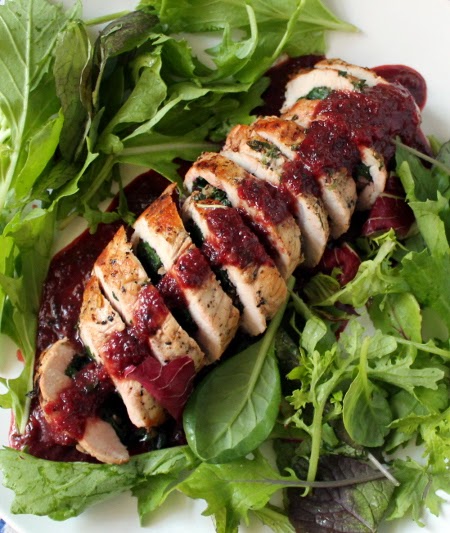
Pork roulade with beet greens and plum-thyme sauce
When you have a backyard full of plums -- especially if you're just not that into jam -- you really have to get creative about using them. So we decided to get fancy. How about a savory plum sauce?
We could have gone for the classic Chinese plum sauce with spring rolls, but we also had a bunch of fresh thyme and that beautiful CSA honey kicking around. So a more French-inspired sauce seemed in order. And what could we serve with this kind of sauce? The obvious answer is pork. How about a roulade?
So. We're essentially going to butterfly a pork chop per person, make a filling of greens and nuts, stuff the chop, and sear until done. Then we'll simmer pureed plums and seasonings to make a sauce. The end result looks complicated, and is amazingly delicious, but it's really not very difficult to cook at all.
This recipe will make enough filling and sauce for two pork chops. Any extra greens are delicious as a side dish.
If you want to feed a crowd and use up a boatload of plums, you can also double the filling and sauce recipes and stuff an entire pork tenderloin. You'll just need to roast it in the oven for a bit after searing, since such a large piece of meat won't cook through with just a sear. And OH MAN would that crowd be impressed when you served it. I'm just saying.
If you don't eat meat, you can still try out the greens and sauce! Cook them both (minus meat juices, of course), roast some potatoes, sear a piece of tofu, and you're all set for a delicious dinner. And I have one more vegetarian-appropriate sauce application to come later this week. Stay tuned!
Pork roulade with beet greens and plum-thyme sauce
Filling:
butter/olive oil
4 cloves garlic
1 bunch beet greens
double handful almonds, raw or roasted
salt & pepper
Roulade:
1 deboned, trimmed pork chop per person OR split it between two less meaty eaters
more salt & pepper
4-6 sprigs fresh thyme per chop
meat mallet or rolling pin
cooking twine or tinfoil to tie
Plum sauce:
butter/olive oil
~ 1 cup chopped fresh plums
1/2 cup water
leaves of 4 sprigs fresh thyme
1 tbsp honey, to taste
2 tbsp dry white wine
yet more salt & pepper
Start by making the roulade filling. Melt a pat of butter in a wide saute pan while you crush and slice a few garlic cloves. Add the garlic to the pan and cook for 2-3 minutes, or until it begins to turn golden.
Wash and chop a bunch of beet greens. You can also sub in chard or spinach here if you prefer (though spinach will cook down more, so you'll need two bunches if you go that direction).
Add the greens to the pan and season with salt and pepper. Cook, stirring occasionally, for about five minutes, or until the greens are wilted. Chop your almonds and add them to the greens. Mix it together, and your filling is done.
Now is the time to start heating your meat pan. Just put a sufficiently large stainless steel or cast iron pan over medium-high heat and let it warm up while you're prepping your meat. A hot pan will ensure a good sear.
Butterfly your pork chops. You can check out this video for a visual. First, put your chop on a cutting board. Using a very sharp knife, cut gradually in from the side opposite the fat cap, dividing the meat in half horizontally as best you can. If you make a mistake and cut through to the board, it's ok! Just back up and make a correct cut over the mistake. You won't even notice any mistakes once you're done. Cut 4/5 of the way through the chop, leaving it connected at the end. Then open it up like a book. Voila! You just butterflied a pork chop.
Lay your butterflied chop flat and cover with a piece of plastic wrap or butcher paper. Use a meat mallet or rolling pin to pound it to an even 1/2-inch thickness.
To stuff your chop, season it liberally with salt and pepper and arrange it nicest side down. Put several spoonfuls of filling down the middle of the chop. You want to use just enough filling to let the meat wrap completely around it; mine is a little overfull here.
Roll up your chop and secure it with butcher twine or a few strips of tinfoil. I used a classic butcher's truss (video), but it's totally fine to improvise. Tuck your sprigs of thyme under the twine in several different spots around the chop.
Sear your roulades quickly on all sides in the prepared pan. It should take about three minutes per side to get a nice golden brown crust. If the roulade sticks, your pan may not be hot enough, or the meat may not be completely seared yet. Turn up the heat or try a few good shakes to release the meat from the pan.
When your roulades are seared, remove them from the pan to a plate and let them rest, covered loosely with foil, for a good five to seven minutes. Resting meat is super important! It will give the hot juices time to reabsorb into the meat, making for a juicy and evenly cooked roulade.
While you're waiting, it's time to make the sauce. Wash and chop your plums. Put them in a blender with the water and liquefy as best you can. There will be bits of plum peel floating around; that's ok.
Pour the liquefied plums into the same pan you used for the roulade and cook over medium-high, stirring to deglaze the crystallized meat juices. You can also add any accumulated juices from the meat plate. Add the thyme, honey, and white wine, season with a scant pinch of salt and a few grinds of pepper, and cook, stirring frequently, for about five minutes, or until the sauce is thickened and reduced to approximately half its volume. Correct the seasonings, and your sauce is done. Hooray!
It's time to serve! Remove the butcher twine and thyme sprigs and slice your roulades into six or eight medallions each. Arrange them on a plate (on extra greens if you have any, or in a puddle of sauce if not) and ladle a few spoonfuls of sauce over the top. Four slices is a perfectly adequate serving, especially with some mashed potatoes and salad on the side; an entire roulade is a huge but very satisfying serving. It's all good.
Now serve it to your amazed guests. Or, you know, yourself.
This is hands down one of the best dinners we've made in months.
PS: Want more roulades? How about a venison roulade?
21 May 2014
Serious catch-up catch-all
Where am I? What's going on?
Someone got a nice fancy tray of surprise breakfast in bed. I made migas and coffee for ultimate delight.
Note that the tray was too small to hold an actual plate. As such, that is a very full salad plate.
If you have both leftover rhubarb syrup and a garden bed full of mint, you will end up making a mojito or two. Definitely very refreshing on a hot hot afternoon.
I also drank a good pitcher of iced black tea with spoonfuls of rhubarb syrup in each glass. VERY good idea. Possibly an even better idea than the mojitos.
LUNCHTIME.
This kind of melange is so typical that I don't normally bother to take pictures. Seared chicken sausage, green beans, summer squash, parsley, and some red pepper flake, all mixed up with a handful of spaghetti.
The leftovers were good for pre-dinner I'm-way-too-hungry snacking.
On Sunday afternoon we had more green beans for feast spectacular, along with the first apricots and nectarine of the season and a wedge of very crumbly raw aged cheddar.
There was also a baguette and a lot of hummus (not pictured).
Speaking of the first of the season, how about some peas? Boiled, drained, buttered, and eaten.
The tilapia was super simple too. Toss in seasoned flour, sear in butter, cut a wedge of lemon for garnish. The end.
What delicious dishes have you been throwing together and forgetting to post about?
Someone got a nice fancy tray of surprise breakfast in bed. I made migas and coffee for ultimate delight.
Note that the tray was too small to hold an actual plate. As such, that is a very full salad plate.
If you have both leftover rhubarb syrup and a garden bed full of mint, you will end up making a mojito or two. Definitely very refreshing on a hot hot afternoon.
I also drank a good pitcher of iced black tea with spoonfuls of rhubarb syrup in each glass. VERY good idea. Possibly an even better idea than the mojitos.
LUNCHTIME.
This kind of melange is so typical that I don't normally bother to take pictures. Seared chicken sausage, green beans, summer squash, parsley, and some red pepper flake, all mixed up with a handful of spaghetti.
The leftovers were good for pre-dinner I'm-way-too-hungry snacking.
On Sunday afternoon we had more green beans for feast spectacular, along with the first apricots and nectarine of the season and a wedge of very crumbly raw aged cheddar.
There was also a baguette and a lot of hummus (not pictured).
Speaking of the first of the season, how about some peas? Boiled, drained, buttered, and eaten.
The tilapia was super simple too. Toss in seasoned flour, sear in butter, cut a wedge of lemon for garnish. The end.
What delicious dishes have you been throwing together and forgetting to post about?
Labels:
breakfast,
dairy,
easy,
fast,
fish,
looks a mess; is delicious,
meat,
pasta,
vegetables
17 February 2014
Zürcher geschnetzeltes with chicken
I had never heard of Zürcher geschnetzeltes until last week, when someone mentioned it randomly on ravelry. The translation is just "sliced meat Zurich style." That's not very descriptive, so it's a good thing the reality is much more enticing: a rich and fragrant dish of sliced veal and mushrooms in a white wine and cream sauce. SUPER EXCITING. This clearly needed to happen, if only so I could pretend that it's actually winter here in drought-ridden California.
There was just one catch. Our usual grocery store didn't have any veal--and honestly there isn't a lot of red meat happening at our house anyway. So I decided to make this with chicken.
Yes, chicken, arguably the most boring of all meats! And yet, I like chicken, and I thought it would be excellent in a white wine and cream sauce with mushrooms and sage. What better way to avert the biggest problem with chicken--dryness--than to smother it in sauce? With some attention to size and cooking time, it worked out very well.
I made the mistake of not thinking about what I was going to serve this with until it was entirely finished and ready to go. Evidently the traditional Swiss accompaniment is rösti, which would be pretty amazing. A steaming spoonful of egg noodles or hot mashed potatoes would also work well. But I ate mine all by itself, with a little bread to sop up the copious sauce left on the plate, and was still well content.
Since I'm the only meat-eater in the house, I just made enough for me, but you can double or triple at your leisure.
Zürcher geschnetzeltes with chicken
Adapted from traditional Zürcher geschnetzeltes.
1/2 lb chicken, skinned (about 1 chicken breast or 2 thighs)
flour to coat
butter AND olive oil
1/2 yellow onion
2 garlic cloves
10 sage leaves
12-14 large button or brown mushrooms
1/2-2/3 cup of dry white wine (enough to deglaze)
2/3 cup cream
salt, pepper, paprika
Start by slicing a chicken breast (or whatever cut you like--deboned thighs would certainly be easier to keep moist here!) into pieces about 3/4-inch thick. Toss to coat in a couple tablespoons of flour, tapping off any excess.
Heat a wide, heavy-bottomed saute pan on high. Add a pat of butter and a small slug of olive oil. When the butter foams, add your chicken pieces in one layer. Sear quickly for about three to five minutes per side. While you're waiting, cut your onion into thin half-moons and your garlic into slices. Slice your sage leaves into thin strips, reserving a few leaves for garnish.
When your chicken has a beautiful golden-brown crust on both sides, remove to a plate. Don't worry about the meat being fully cooked at this point! You just want a nice sear.
Turn the heat down a touch, add another bit of butter and olive oil to your pan, and throw in your onion, garlic, and sage. Saute for about five minutes, or until the onion has begun to soften.
Cut your mushrooms into wide slices and add them to the pan with a pinch of salt. Cook, stirring occasionally, for about five minutes. Then add your wine to the pan, stirring to deglaze. Finally, add your pieces of chicken and their juices, as well as some salt, pepper, and paprika.
Mix everything together and cook until your chicken is done, being careful not to overcook. Mine was ready in about five minutes, but the timing is going to depend on exactly how big your pieces are. Cut a thick piece in half to check.
At the last minute, add your cream to the pan. Stir together and cook for another minute, or until warmed through and just beginning to bubble.
Voila! A beautiful dish of tender chicken and mushrooms in a savory cream sauce! Serve over the noodle, potato, or grain of your choice, or just fill up a bowl and eat it by itself.
You clearly want a green vegetable of some type on the side if you can possibly swing it. My first choice would be a big pile of simple steamed spinach with butter and salt. I wouldn't say no to a big spoonful of baby peas, either. And a big crispy salad is always a nice contrast. It's all good--just get something green in your face.
This was rich enough that I couldn't eat it all at once, and thus I can report that it's also excellent eaten cold out of the fridge the next morning. Hooray, leftovers for breakfast!
What thick, hearty stovetop dinners are warming you up this winter?
10 January 2014
Lamb burgers with yogurt and dijon mustard sauce
Well. The beginning of 2014 has turned out to be unexpectedly challenging so far. I for one am feeling pretty tired and ready for some serious comfort food. It's time for burgers.
At our house, burgers are usually Jenna of good good things' BBQ pinto bean burgers. You should absolutely give these a try, if you haven't already. SO GOOD. I made up a huge batch to freeze several months ago, and was that ever a good idea. The only problem was that we ate them all, and I haven't made up another batch yet.
So this time, exhausted and in need of immediate protein infusion, I went for a lamb burger.
Lamb is absolutely my burger meat of choice. Beef has that tallowy mouthfeel; pork is too much fat all at once; chicken is boring and easy to overcook. Lamb, in contrast, is delicious and strong, juicy and intense, and it matches super well with all the seasonings I like best (read: practically all of them). Ginger and lemongrass, soy sauce with hot chili pepper and garlic, feta and artichoke, bell pepper and onion piperade--any combination is delicious.
I grabbed a red onion and a bell pepper, ripped up a piece of bread, and went to work. Burgers!
For garnish, I decided to make up a micro-batch of a really easy, really delicious sauce. It's the easiest thing on the planet: plain yogurt with dijon mustard. This stuff is the best possible idea as long as you like both yogurt and mustard. Mixing them together creates a spicy, tangy sauce that is far more than the sum of its parts, and takes literally seconds to make. Perfect.
The mighty lamb burger
1/4 of a red onion
1/4 of a red bell pepper
1/2-2/3 cup breadcrumbs
1/2 lb ground lamb
salt, pepper
Start by chopping your vegetables as finely as possible. Finer bits will adhere better to the finished burgers. You can, as mentioned, add more things to your lamb burgers. Some garlic would be nice, as would a big handful of fresh parsley, but this time I kept it simple.
If you don't have any breadcrumbs around, chop up a piece of bread too. No problem! Also no trips to the store to buy something as cheap and easy to make as breadcrumbs.
Note that breadcrumbs are mandatory in a good burger. They keep it moist and tender, eliminating the "solid meat hockey puck" issue. Do not make these without breadcrumbs.
Mix everything together in a big bowl with your hands. Yeah!!
Form the meat mixture into reasonable burger-sized patties. I made three from this amount, but you could definitely make four slightly smaller patties if you wanted to. Freeze any burgers you don't want to cook immediately with a square of parchment paper in between them. Then you can just defrost and cook them in times of future burger emergency.
Fry your lamb burgers over high heat for about four minutes on the first side. Flip, reduce the heat, cover, and continue to cook on medium to medium-low for another four or so minutes. The time is going to depend on how hot your stove runs, so check for doneness and cook longer if necessary. Just imagine you're making a grilled cheese sandwich and you should be good.
Serve on a delightful toasted bun with the condiments, cheese, and vegetables of your choice. I used the aforementioned yogurt and mustard sauce plus a whole lot of crispy romaine lettuce. Fries are not mandatory, but they're certainly recommended.
Yogurt and dijon mustard sauce
plain full-fat yogurt
dijon mustard (or probably any good spicy mustard)
This is the easiest sauce ever. Simply mix together roughly equal amounts of yogurt and mustard until smooth. Taste and decide whether you want to spice it up with more mustard or tang it up with more yogurt.
Serve on a lamb burger, as a dipping sauce for fries, or use to garnish cooked vegetables. I tried this with roasted carrot, and it was excellent. Steamed broccoli is on the to-try list as well.
Together, these guys made a plate of comfort food at its finest. What hearty dishes are you cooking in the depths of winter?
Labels:
condiments,
dairy,
easy,
fast,
meat,
recipes,
sandwiches,
sauces
02 December 2013
Thanksgiving in pictures
Everyone needs some arts and crafts to start off the holiday right. We ate a lot of Paper Doll Parade's maple rosemary roasted nuts while searching through every shade of brown, orange, yellow, and red the Crayola 64 assortment had to offer.
This was the first Thanksgiving at which I've had meat since 2006. I made some salami tidbits (which, true to form, everyone stood around the stove and ate as soon as possible) and Veronica and Simon, who were so kind as to host, brined and roasted a chicken.
The full dinner menu: the aforementioned chicken, roasted potatoes and carrots, mashed sweet potatoes mirepoix, salad, and lots of gravy. I also made apple dumplings for dessert. Needless to say, everyone was VERY FULL.
Here's my plate before liberal application of gravy. SO MUCH GRAVY. That was by far the best part of having meat for Thanksgiving. I can totally cook and eat a gigantic vegan celebratory meal with no problem except for the lack of good gravy.
SO MANY LEFTOVERS. The chicken carcass got tossed immediately into a stockpot for stock. (I also made stock a couple days later from the few bones and skin and etc that came home with me.)
Of course you know what leftovers mean. They mean that the next morning you can cut open a bagel, toast it nicely, and layer on all the sweet potato, chicken, and salad greens in the land. Some cream cheese made an appearance as well. So did a big cup of hot black tea with the season's first big whack of eggnog.
Definitely the perfect ending to a celebratory weekend.
I hope everyone had a wonderful holiday!
Labels:
holiday,
meat,
potato,
soporific,
vegetables
21 November 2013
Salami tidbits
Thanksgiving is suddenly next week! How did that happen? Clearly it is time to think about huge platters of appetizers. Okay! How about filling salami slices with a plentitude of delightful bits and pieces, making them into convenient bite-sized rolls, and frying them until hot and crispy?
We invented these guys several years ago, while we were living in Brooklyn and had access to the particularly amazing deli & meat counter at the Greene Grape Provisions. So much salami! Of course we had to find more ways for me to eat it than just in sandwiches, although those were well worth it too. This led to an evening of hovering over the stove, eating hot salami rolls right out of the pan. SO GOOD.
These tidbits would be especially good for a party because you can make a whole huge whack of them the day before, shove them in the fridge, and quickly fry them when you want to serve. It only takes about five minutes of last-minute cooking to produce a big platter of delicious bits. Hooray!
You'll want to either get your salami sliced to order at your local deli or buy it in pre-sliced packaged form. The thinness of the slices is key to making a tidbit that is flexible enough to roll, but not too greasy.
The other ingredients are easily interchangeable to your tastes. No mozzarella? Monterey jack, parmesan, or even a smear of cream cheese will be fine. Don't like mushrooms? Leave them out. Don't have bell peppers? Quarter some grape tomatoes instead. It's all good.
(The mushrooms up there were good too--stuff brown mushroom caps with simple pesto, add cheese if you want, and heat quickly under the broiler--but basil is pretty much over at this point, right?)
Salami tidbits
thinly sliced hard salami, roughly 3-inch diameter
mozzarella
bell peppers (any color but green)
mushrooms
spinach or chard leaves
fresh parsley
good, solid wooden toothpicks (the cheap ones will break)
paper towels for blotting
Start by cutting all your cheese and vegetables into short, thin strips. The actual size will depend on the size of your salami slices. You want the fillings to fit securely inside a roll of salami for the duration.
Assemble your rolls by stacking a bit of each filling ingredient in a line down the middle of a piece of salami. Roll it up (or fold it in from both sides, depending on how full things are) and secure with a toothpick, punching in and out once like you're sewing a stitch. You don't have to go through the entire roll; just secure the loose ends of salami. Repeat until you have as many rolls as you want.
At this point you can cover your tidbits and put them in the refrigerator until right before you want to serve them.
When you want to serve, heat the frying pan of your choice on medium. Fry your tidbits, shaking the pan occasionally, until they start turning golden brown and crispy on both sides. Since salami has plenty of fat to render, you won't need to add any extra oil. Use a big enough pan, and you can fry all your tidbits at once for a super fast finish.
Remove your finished rolls to a paper towel and blot briefly. Arrange on the plate of your choosing and serve hot.
Now try to leave a few for your guests instead of just eating them all yourself while standing around gossiping in the kitchen.
What kind of appetizers are you planning for your Thanksgiving festivity?
23 October 2013
Chicken, broccoli, and coconut milk
I was about to leave the office a couple days ago when Bethany said, "so, any ideas for dinner?"
After giving the least helpful answer ever--that is, "Dinner??", accompanied by the classic deer-in-headlights stare--I mentioned that we had both chicken and broccoli. Bethany mentioned coconut milk. Ok! Chicken, broccoli, and coconut milk it is!
As you can see, this was super simple. As you can perhaps imagine, it was also delicious.
The big issue was defrosting the chicken, and even that turned out not to be such a big deal once we got the pieces actually separated. It's just hard to submerge a long thin row of chicken breasts in hot water when all you have is a medium-sized bowl or two.
Obviously we were eating meat, but I'm thinking you could do something very similar with a bunch of chickpeas or navy beans and a hit of extra spice for ultimate bean & green & coconut milk goodness.
This fed four adults and two children, with no leftovers.
Chicken and broccoli with coconut milk
oil/butter
a big yellow onion
5 chicken breasts or equivalent amount of meat/beans
~1 cup coconut milk
~2 heads of broccoli (we used 3 small heads)
salt, pepper, curry powder
Start by warming some oil or butter in a wide, deep saute pan (make sure you have the lid) while you chop up an onion. I'm pretty sure we just used standard veg oil for this one, but whatever you like should be fine. Special bonus if you have coconut oil around.
Dump the onion into the pan, stir to coat with oil, and cook for about five to eight minutes, or until it starts turning translucent.
When your chicken is reasonably defrosted, put the pieces into the pan with your onion. Cook to brown on one side. When there's some beautiful golden caramelization going on, flip all your pieces of chicken over and brown the other side.
Next, pour about a cup of coconut milk, well shaken, over the pan of chicken and onion. You can use more if you want a saucier end product. Season with salt, pepper, and curry powder (or the spice combination of your choice. We had curry powder, so that's what happened). Then put the lid on your pan, lower the heat slightly, and let cook for a good ten or fifteen minutes. You want to get the chicken cooked through, but also keep it moist. Coconut milk certainly helps with the moist & juicy aspect of the situation.
While you're waiting, chop a head of broccoli into reasonable pieces. Peel the stems and chop them too. Nose to tail, you guys. Plus broccoli stem is delicious. Speaking of broccoli stem, if you happen to have some CSA kohlrabi hanging around, you could peel & add that too.
When your chicken is closing in on done, dump your broccoli into the pan. Put the lid back on and continue cooking for another seven or eight minutes, or until your broccoli is done to your liking. Test to make sure the meat is cooked through, & let cook a bit longer if needed.
Serve everyone big chunks of chicken and spoonfuls of broccoli and onion. We had ours by itself, but this would obviously be excellent over a pile of rice or egg noodles too.
Hooray! Dinner!
Wow, did writing this all out make me hungry. It was really good, you guys. Also, maybe I should have eaten something besides a piece of peanut butter toast so far today.
What delicious dinners have you randomly created lately?
14 October 2013
Brussels sprout, onion, and apple hash
One thing about Portland is that it's actually cool outside. The sky is grey. It rains occasionally, although I for one am finding it surprisingly dry so far. And that means the seasonal vegetables actually feel seasonal.
In California, we're often eating broccoli and kale while it's still 75F outside. Here, not so much--and it makes the winter veg taste so much better.
What I'm saying is: I made some brussels sprouts and they were great.
Sprouts definitely have a few natural partners in the food world. Onion, apple, and bacon all play extremely well with them, or really with any dark winter green. So it was lucky for me that all four of those things happened to be in the kitchen one night when I was looking for dinner. I chopped everything up, threw them in a hot pan, and was eating a big plate of dark green hash in under fifteen minutes. Hooray!
The amounts in this recipe are really flexible. You want maybe 1 slice of bacon per dinner-sized serving, roughly equal amounts of onion and sprouts, and a touch less apple. And if you don't do bacon, you can always use butter or the oil of your choice, and then add a bit of liquid smoke to the pan at the end of cooking--or just eat it as-is. It's not like brussels sprouts and onions aren't going to be delicious, right?
I considered frying an egg to put over the top of my finished hash. If you're in the runny egg yolk club, you should definitely try this out. Rich egg yolk over a smoky, hearty, veg-filled hash is clearly one of the greatest things in life.
Brussels sprout, onion, and apple hash
bacon/oil of choice
onion
brussels sprouts
apple
salt, pepper
optional sage, thyme, maybe some smoke seasoning
Start by chopping a piece of bacon into small bits. If you prefer to use oil or butter instead, that's cool too--just be prepared to spice a bit more heavily later.
Put your bacon into a hot frying pan or skillet of your choice. Cook, stirring occasionally, until the fat is rendered and the meaty bits are starting to crisp.
While you're waiting, dice an onion. Add the onion and a pinch of salt to the pan and continue to cook.
Wash, trim, and slice your brussels sprouts. I quartered mine and then cut any particular big pieces in half again. If you want to go for the thin shred, you can do that too--the pieces will just need less time to cook.
When your onion has softened, add your sprouts to the pan. Keep cooking, stirring occasionally, while you dice up half an apple.
Add the apple to the pan along with some salt and pepper. If you didn't use bacon, you may want to add some other spices, such as sage and thyme; I just let the bacon be my main seasoning.
Cook for another three to five minutes, or until everything is done to your tastes. If you want to top your hash with a fried egg, now is the time to fry it.
Serve, either alone or with egg on top.
I found this to be excellent with a beer on the side for dinner, but it could take a cup of strong coffee for breakfast equally well.
What fall veg are you cooking and eating lately?
Labels:
cheap,
easy,
fast,
looks a mess; is delicious,
meat,
recipes,
vegetables
28 August 2013
Toaster oven pita pizza with eggplant pickle and heirloom tomato
The other day I wanted pizza for lunch, but didn't want to expend any time or effort making a crust. So I decided to break out some pita bread and use it as the crust for a tiny & nearly-instant pizza.
As I poked around the refrigerator, trying to decide what I could use for sauce, my eyes fell on the jar of pickled eggplant with red wine vinegar, made from Marisa's recipe. I've been struggling a bit to find good ways to eat this, simply because it is so strong. But on pizza? Perfect!
I finely chopped a few eggplant pickle spears and spread them on the pita as my line of first defense. Was it a good idea? YES. The tang is reduced a bit though cooking, but it still provides a delicious and slightly mysterious base for everything else. That pickle, topped with an arrangement of chopped salami, big slices of backyard tomato, chunks of mushroom, little bits of hot pepper, and several slabs of mozzarella, made one of the best lunches I've had in quite a while.
A good pizza definitely needs a huge blast of heat to crisp up nicely. Generally this requires an oven. But not this time! Instead, I turned to the toaster oven: my favorite small appliance ever.
The toaster oven not only warms small items, but actually cooks them. You never get the gross spongy quality of microwaved food--because it's an actual tiny oven. Toast gets crisp and nice, and yet you can also cook things bigger than a slice of bread. Open-faced sandwiches topped with cheese go into our toaster oven regularly, as do giant bagels, servings of last night's rice and curry (with a bit of water to re-steam the rice), frozen homemade belgian waffles too big to ever fit in a toaster, and even occasional bowls of soup. Oven-safe dishes are a must, and you should certainly employ oven mitts as needed, but those are the only real caveats to consider.
In this particular case, since my crust was already baked, I only had to worry about searing all the toppings adequately. This meant I could sit down to eat my finished pizza a bare ten minutes or so after dreaming it up. It was perfect: fast, crispy, and delicious.
You can absolutely use any combination of ingredients you like on a pita pizza like this. Just go through your refrigerator and pick out whatever looks good to you. That's really all I did to come up with mine.
Pita pizza with eggplant pickle and heirloom tomato (among other things)
pita bread
optional olive oil
eggplant pickle
heirloom tomato
salami
hot pepper
mushrooms
mozzarella
oregano, basil, hot pepper flake
If you like, you can prepare your pita by brushing it with a thin layer of olive oil. If not, that's fine too. I didn't use oil because I was using salami, which has plenty of its own oil happening already.
Chop a few spears of eggplant pickle as finely as you can. Spread them thinly over your pita. They will be your sauce layer.
Slice up all the vegetables, meat, or cheese you want on your pizza. Layer them over the pita, finishing with the cheese layer. Sprinkle some oregano, basil, and hot pepper flake over the top, and you'll be ready to go.
It's best to be a little sparing with the toppings, so everything cooks evenly and your crust doesn't get soggy. If you want more toppings, make two pita pizzas.
Bake in a 450F toaster oven (or an actual oven--it's all good) until your ingredients are seared nicely, your cheese is golden brown, and your crust is beginning to turn brown and crispy around the edges.
This particular combination of ingredients was wet enough to generate some of its own liquid, mostly due to the very juicy tomatoes. To avoid drippage issues, it's a good idea to bake your pizza on a pan instead of just the toaster oven grate (which is what I normally do). You could also line the bottom of the oven with aluminum foil to catch drips, but a pan is safer, especially if you have an exposed heating element. Then, if there's any liquid accumulation, you can simply tilt the entire pan to the side and let it evaporate against the hot metal.
Cut your finished pizza into four pieces. SERVE.
This pizza was excellent all by itself, but I also find that tossing a couple handfuls of raw spinach or arugula on top is more than worth the two seconds of effort.
Items: 1. toaster ovens vs. other small appliances 2. best uses for eggplant pickles 3. favorite pizza toppings. Discuss!
Subscribe to:
Posts (Atom)