
Showing posts with label books. Show all posts
19 July 2012
Frugally Delicious and Mussels and Fennel in Ale
A few weeks ago I got a lovely email from Joey at 80 Breakfasts, informing me that I'd won a very exciting blog contest--and lo, my package has now arrived, all the way from the Philippines! What is it what is it what is it what is it what is it?
It's the Frugally Delicious cookbook!
This little book focuses on ideas for cooking and eating well on a budget: a skill even the thriftiest of us could use help with from time to time. 55 amazing foodbloggers contributed their dishes to make this project a reality.
Overall, the aesthetic is clean, with minimal line drawings illustrating each chapter heading, and a great variety of recipes hiding behind the charming facade. The compact format makes the book easy to use; just page through, tuck a corner under a cutting board, and get cooking.
I obviously had to make something right away--but what? I decided on the third recipe in the book: The Year in Food's Mussels and Fennel in Ale.
Steamed mussels generally look really impressive but take almost no effort or monetary layout, and this version was no exception. The combination of Belgian white (Leffe Blond for us) with fennel and onion created a highly fragrant broth studded with tender shellfish.
The proper way to eat mussels in broth is of course to slurp out the shellfish and then use the shell to scoop up as much broth and veg as possible. Soak up more of the broth with your choice of crusty bread; we had sourdough, which was a perfect match.
These mussels were super easy, fast, and intensely flavorful: an ideal appetizer or quick dinner for those of you who like both shellfish and anise.
Hooray! Thanks again for the cookbook, Joey--I'll definitely be trying out more recipes in the future!
30 April 2012
Carrot and white bean soup
This is one of those standard meals at our house, one that's super easy and delicious and not really notable...until you start eating it. Why would I need to take pictures of carrot and white bean soup? We make carrot and white bean soup over and over! It's totally normal! AND YET. Both John and I started eating and couldn't stop, and I was super excited to see what we had a good three servings left over to freeze for later.
What made this so good? Well, I think one element was definitely the great farmer's market carrots. These sweet spring babies are a far cry from anything you'd find languishing in the grocery store produce department. What else? I had soaked and boiled the beans from dry a week or so ago, and had thrown them in the freezer for applications exactly like this one. I used a good farmer's market onion. I made vegetable broth from scratch. I deglazed the pan with dry vermouth. And I ate my serving with a bunch of greek yogurt, sambal oelek, and chopped cilantro stirred in, although John had his plain. Anything else?
Carrot and white bean soup.
butter/olive oil
an onion
a couple cloves garlic
two stalks celery
six big carrots
salt, pepper, oregano, marjoram, red pepper flake
dry vermouth
about 2 cups cooked white beans
3 cups veg or bean broth
an immersion blender
garnish: plain yogurt, cilantro, sambal oelek/other hot pepper sauce
If you don't have homemade broth, put some on to cook first. Just fill a pan with a selection of vegetable odds and ends, cover with water, bring to a boil, and let simmer for about fifteen minutes while you're doing the actual soup prep. Drain out the veg before you use the broth in your soup. Easy.
Start by chopping up your onion and garlic and softening them in olive oil or butter over medium heat. I used a big chunk of butter and just a little oil to raise the smoke point. While those are softening, finely dice a couple ribs of celery. Add them to the pan as you finish chopping. Then scrub all your carrots under the faucet, trim them, and dice them up. Add those to the pot as well. Season with salt, pepper, oregano, marjoram and red pepper flake to your taste. You may want to overseason a bit since the white beans will provide one big neutral palette later.
Stir everything up and let cook for a good five minutes. Then add maybe half a cup of dry vermouth, stir, and deglaze any bits stuck to the bottom of the pot. Bring this mixture up to a simmer before you add the beans and broth.
Since I had precooked beans frozen in a block of broth, I just tossed the entire thing into the pot and let it melt. If you're using canned white beans, drain them before adding them, and just use all vegetable broth. I poured maybe two or three cups of my hot, freshly made veg broth over the top of the bean block to speed up this process (and to have enough liquid to make soup, of course). Bring the entire shebang to a boil, lower the heat to simmer, and let cook for maybe five to ten minutes, or until everything is cooked through and the ratio of liquids to solids is appropriate to your tastes.
Now take the pot off the heat, give it a minute or two to cool, and puree it with an immersion blender. You can, of course, eat your soup unblended if you prefer; we just like thick pureed soups, and the beans give this one an excellent smooth texture.
At this point you can put the pan back on the heat to reduce and thicken a bit more, or you can just go ahead and eat it.
The finished product is super-carroty, with thickness and protein from the beans--a full meal in a bowl. It's great by itself with just a little sprinkle of pepper or chopped green onions. However, I think it's even better with a big spoonful of plain yogurt, a handful of chopped cilantro leaves, and spice to taste. I used a small spoonful of sambal oelek; you can use whatever you want.
Eat by itself, or with a hunk of sourdough, green salad, or tasty sandwich of your choice. Yay, soup!
Labels:
beans,
books,
dairy,
easy,
farmer's market,
potentially vegan,
pulses,
soups,
vegan,
vegetarian
25 January 2010
Muffin muffin who's got the muffin
OK, how awesome are Heidi's espresso banana muffins? So awesome! And that's coming from someone not particularly into baking and/or baked things other than bread. These are from Super Natural Cooking, which is generally pretty great. And how great is it that Heidi's now working on another book? So great! Lack of adjective variation represent!
Ok: muffins. First, I am not into walnuts, so those were out. Next, I always have straight up wheat flour instead of white/wheat or any other variants, so I subbed that in. Of course there wasn't enough wheat flour, either: only a cup and a half instead of two cups. So instead of using chickpea flour or cornmeal, which were the only other flours in my freezer, I went for the bag of almonds. I finely chopped half a cup of those to sub for the missing flour, and did it ever work well. This made for 14 dense, fairly damp, exciting muffins.
That is, it would've made 14 of them had I not tipped the second muffin tin over the edge of the oven. Excellent move on my part! Of course, we got eight muffins out of the deal, so it wasn't a complete tragedy. We still managed to eat quite a few of them in a very short period of time.
05 November 2007
Lunch at Joann's
Anyway, we went to my friend Joann's to admire her new house and shower her with champagne for getting her PhD. OK, actually to drink the champagne and cook and eat and wander around her neighborhood feeling astonished that there is actually some part of the bay area that we'd actually want to live in.
Menu:
pistachios, pears, cheese, and bread
kabocha squash salad
sweet potato gnocchi again
mozzarella, tomato, and basil panini
lots of red wine
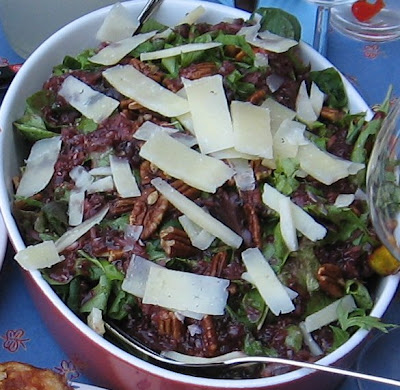
Joann was really excited about making her squash salad. It was a recipe from Sunday Suppers at Lucques, a cookbook I had heard of but never had the chance to see before. Perhaps one of these days I will have to borrow it and see what else is as delicious as this, because this was perhaps the best salad ever. We did have to modify the dressing, because it was all about lardons of bacon and two out of the five people eating were vegetarian. Seriously, the recipe text went into great detail about exactly what constitutes a lardon. It's just cut up bacon! Anyway, even though I'm not sure what that dressing would be like (although probably good, because hot bacon dressing on dark greens? The answer is yes), I can tell you our sub dressing was fantastic.
Kabocha squash salad from memory
a kabocha squash
some whole pecans
mesclun mix
parmesan
dressing: shallot, butter, bottled raspberry mesquite sauce
First, roast the pecans: put them in a pan and put them in the oven for a few minutes. Since nuts are liable to scorch and burn, I'd put them on at a lower temperature and watch them closely. Ten minutes at 200F sounds about right. When they are clearly fragrant and awesome, take them out and let them cool.
The hardest part of this is cutting up the squash. While the nuts are roasting, take a whole kabocha and whack it in half with a knife. Scoop out the seeds; Joann had an old ice cream scoop that worked really well for this. Cut off the stem and blossom scars. Now we come to the most annoying part: peeling. Since winter squash is too hard for any junky vegtetable peeler, we used a knife and painstakingly cut all the skin off the outside of the squash. It took a while. Then we cut the peeled squash into inch-thick slices and Joann put them in the oven to roast. She might have tossed them with olive oil to do this; it seems likely, but I'm not sure. Roast your squash in the 350F range until soft and starting to brown. This will take about a half hour, from what I recall. Take them out and let them cool as well.
While the squash is roasting, make dressing. We just chopped up a shallot finely, sautéed it in butter, and added some commercial sauce. Joann had chosen that sauce since it had mesquite, and so would taste smoky without actually being made of bacon. All we did was warm it up with the shallot, and it was ready.
To assemble: fill a bowl with mesclun mix and roasted squash; toss with some dressing. Add pecans and strips of shaved parmesan. Add more dressing if you want. That is it.
We also had panini. Joann was disappointed in the panini since they weren't as crispy as she wanted. I was not at all disappointed because I prefer softer sandwiches and these are damned delicious. I did nothing to prepare these but take a couple pictures, but they seemed pretty easy. They were an excellent way to break in her new panini pan. I'm going to call them panini caprese since the filling combination was exactly the same as the ingredients for a caprese salad.
Panini caprese
good bread
mozzarella
tomato
fresh basil
olive oil
probably salt and pepper
Cut up the bread into good inch-thick slices. Rub both sides of each slice with olive oil.
Cut up tomato and mozzarella and layer the slices on the bread. Wash basil, rip leaves off stems, and layer them in as well. Add some salt and pepper if you want. Top with another piece of bread.
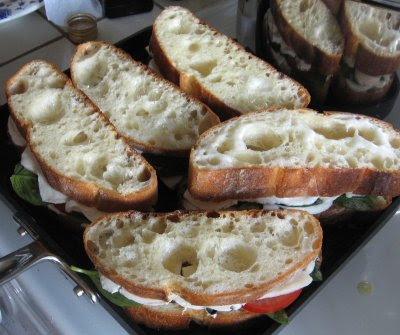
Cook, weighted, until first side is browned and delicious. Then flip and do the same to the other side.
We also got to show off our gnocchi-making prowess. Everybody helped roll the dough out. There is nothing like communal dough activity to make people like cooking and food.
Now go to the table and eat as much as possible of everything. Have red wine. Talk a lot.
I was particularly enamored of the salad and kept sneaking bits out of the serving dish later.
Labels:
books,
recipes,
salads,
sandwiches,
vegetarian
10 September 2007
I got Super Natural Cooking
My first impression was: what a strange way to organize a cookbook! My second was: I have a lot of these grains already in my pantry. My third was: which thing should I make first? Do I have the full ingredient list for any of these right now? What should I get when I go to the store tomorrow?
Then we started cooking.
1. Otsu
2. Scrambled curried tofu
3. Fig and sesame jam
1.
I was happily surprised by these, at least at first. I generally do not like sesame noodles, and am kind of ambivalent about many Asian noodle dishes, come to think of it. Not if they're hand-pulled, though! I need to learn how to do that sometime. Anyway. John mixed up the sauce, with slight substitutions in type of vinegar, and it smelled great. Great! Saucing is hard; if this sauce is good, the rest of the dish should be good as well.
We probably should have actually tasted the sauce, though, because when the full dish was done and dressed it became apparent that the lemon in said sauce did not work as planned. I still liked it pretty well; John pushed his plate away in disgust. This was pretty astonishing, since our reactions are generally reversed in a sesame noodle circumstance. We sat around and speculated about using lemongrass on our next attempt.
The real success here was the tofu. First, we actually got nigari tofu, as opposed to the usual wildwood stuff. It's clearly the best possible texture tofu to use in any hard-press circumstance, as became even more apparent in #2. Plus, the whole easy searing technique? Why didn't we know this before? It's just "cut tofu; throw in frying pan; brown on one side; brown on other side" but it worked so perfectly we could not believe it. We've already applied it to other food.
2.
These dudes, in contrast, were a total success. For some reason we wanted real egg with the tofu, so we hardboiled and chopped them for exceedingly large garnish.
3.
It was kind of surprising that we made anything from the last section of the book at all, since that section is titled "Use Natural Sweeteners" and contains almost nothing but desserty things. We don't even have a sugar bowl, and are still only halfway through a bag of demerara that my friends gave us two YEARS ago when they moved away. I don't know how we're going to get through the more recent moving donation sugars. The only sweetener that I use at all is honey, and that's pretty infrequent.
We did have figs lying around, though, and a bag of sesame seeds in the refrigerator, and a pepper mill. So I chopped up the three remaining figs and made the tiniest, most estimation-based batch ever. I used barely any honey, but lots of pepper. Then I ate it all right away.
Then we started cooking.
1. Otsu
2. Scrambled curried tofu
3. Fig and sesame jam
1.I was happily surprised by these, at least at first. I generally do not like sesame noodles, and am kind of ambivalent about many Asian noodle dishes, come to think of it. Not if they're hand-pulled, though! I need to learn how to do that sometime. Anyway. John mixed up the sauce, with slight substitutions in type of vinegar, and it smelled great. Great! Saucing is hard; if this sauce is good, the rest of the dish should be good as well.
We probably should have actually tasted the sauce, though, because when the full dish was done and dressed it became apparent that the lemon in said sauce did not work as planned. I still liked it pretty well; John pushed his plate away in disgust. This was pretty astonishing, since our reactions are generally reversed in a sesame noodle circumstance. We sat around and speculated about using lemongrass on our next attempt.
The real success here was the tofu. First, we actually got nigari tofu, as opposed to the usual wildwood stuff. It's clearly the best possible texture tofu to use in any hard-press circumstance, as became even more apparent in #2. Plus, the whole easy searing technique? Why didn't we know this before? It's just "cut tofu; throw in frying pan; brown on one side; brown on other side" but it worked so perfectly we could not believe it. We've already applied it to other food.
2.These dudes, in contrast, were a total success. For some reason we wanted real egg with the tofu, so we hardboiled and chopped them for exceedingly large garnish.
3.It was kind of surprising that we made anything from the last section of the book at all, since that section is titled "Use Natural Sweeteners" and contains almost nothing but desserty things. We don't even have a sugar bowl, and are still only halfway through a bag of demerara that my friends gave us two YEARS ago when they moved away. I don't know how we're going to get through the more recent moving donation sugars. The only sweetener that I use at all is honey, and that's pretty infrequent.
We did have figs lying around, though, and a bag of sesame seeds in the refrigerator, and a pepper mill. So I chopped up the three remaining figs and made the tiniest, most estimation-based batch ever. I used barely any honey, but lots of pepper. Then I ate it all right away.
Labels:
books,
breakfast,
fruit,
grains,
potentially vegan,
vegetarian
Subscribe to:
Posts (Atom)