28 March 2010

Lasagna of awesome

Oh, messy food, you are always the most delicious.

LASAGNAAAAA

lasagna noodles
onion
garlic
olive oil
tomato puree/etc
basil, oregano, salt, pepper
ricotta
mozzarella/etc
an egg
spinach/other greens

Right! So there are a few stages in the making of lasagna. First: sauce.

For the sauce you essentially just want to make a good marinara. Mine was totally basic: I chopped up some onions and garlic, softened them in olive oil, added tomato and spices, added some water to thin it appropriately, and straight up let it cook. Fin. You could put all kinds of delicious business in your sauce if you wanted to: peppers or mushrooms or olives or eggplant or anything else you can think of. It is all delicious.

While the sauce is simmering, preheat the oven (350F) and prep everything else that will go in said lasagna. For the cheese: mix a small tub of ricotta with an egg and a couple big handfuls of grated mozzarella. For the greens: wash them and chop them up. I think I actually used a mix of spinach and chard for this instance of lasagna. You could mix your chopped greens into the cheese if you want, but I didn't bother. It's all going into the lasagna anyway.

For the noodles: it seems like a lot of lasagna noodles are now the no-cook variety. Mine certainly were. However, I had heard that a quick parboil makes them more delicious, so I parboiled mine for about a minute. It worked perfectly and was not too awkward. It probably also helped that I got the wide, short lasagna noodles instead of the long annoying ruffly ones. I used six noodles for the entire lasagna.

Ok! Once your sauce has simmered for maybe ten or fifteen minutes, it's time to assemble. Get out a casserole dish and spread in a layer of sauce. Then add a layer of noodles, a layer of cheese, and a layer of greens. Stack up a second layer of all these, or even a third if your pan is that deep. Add a final layer of sauce, spread grated mozzarella over the top, and stick the whole business into the oven.

Now you have to WAIT. Lasagna takes 45 minutes to an hour to cook. I mean, it clearly makes sense, since you have this huge thick pan of delicious goodness, and it takes time for heat to penetrate that degree of bounty, but STILL. It does give you plenty of time to wash the amazing quantity of accumulated dishes.

When the lasagna is done, plot to steal all the crispy cheese off the top.

Eat as much of it as you can. John and I made it about halfway through the pan before collapsing. Lasagna is very good with red wine (which we actually did not have).

The next morning, eat it for breakfast.

26 March 2010

First asparagus of the season

Well, after slamming my thumb in the closet door a few hours ago, I'm not especially excited about typing anything. I do have pretty pictures, however.

Asparagus! These stalks were barely as thick as a pencil. EXCITEMENT.

So we steamed it for a couple of minutes. I ate it with seared tilapia and grape tomatoes wilted quickly in the leftover olive oil. Lots of lime juice over the top. Excellent plan.

I EAT IT.

23 March 2010

Deliciolous sandwich is deliciolous

Trying to make up realistic spellings for imaginary words is always interesting, especially if the combination of constructions you want occurs nowhere in the English language. It's a good thing I was teaching intensive reading and language expectations for almost five years, is all I'm saying.

Anyway, SANDWICH.

Sesame bagel, cream cheese, red pepper, mushrooms, red chard leaves. If you used hummus instead of cream cheese, that would also work admirably, and be vegan into the bargain.

Notes:

- It's really nice to buy fresh bagels from the bagel shop, take them home, saw them open, toast them just enough to warm them through, and then stuff them with everything in the vegetable drawer.
- Yes, I am including chard in approximately 80% of my food lately; why do you ask?
- Bagel sandwich is excellent with an old fashioned glass of pale ale.

- EAT IT.

22 March 2010

Polenta! Chickpea tomato curry!

A bit ago, we broke into the freezer stash to make polenta for the first time. This was an excellent idea.

Cooking polenta is much less complicated than you might expect from all the instructions floating around. Polenta = grits. There's nothing fancy or difficult involved, and no intimidation necessary. We certainly didn't "pour the grain into the boiling water in a steady stream" et al. We just mixed the grain and the water, stirred it, and cooked it. No problems whatsoever.

I do really wish I'd realized that polenta = grits when I lived in North Carolina, however. Just imagine all the awesome diner breakfasts I could have had! Polenta with poached egg, hot sauce, and a cup of coffee!

Homemade polenta has the same benefit as, uh...most other things you cook at home. That is, you can make it exactly like you want it. If you want soupier polenta, you can add more water. If you want hard polenta, you can let it solidify and cut it up. If you want cheesy polenta, you can add shredded cheese to the finished product. If you want plain essence-of-corn polenta with no ingredients but water and corn, that's fine too.

Plain bare-bones polenta

water
coarse cornmeal
pinch of salt

The proportions here depend on how soupy you want your finished product. I'd use about a cup of cornmeal and five cups of water to start.

In a heavy-bottomed pot, whisk the water and cornmeal together well, eliminating any lumps. Add a pinch of salt. Put the pot over medium or medium-high heat and cook it, stirring most of the time, until the cornmeal is cooked and delicious. This will take about a half hour, but it's really not a big deal. If the cornmeal absorbs too much water for your liking, you might add more liquid. Otherwise, all you have to do is stir.

We had our polenta soupy, i.e. right out of the pot. If you want hard polenta, just pour it into a buttered/olive oiled casserole pan and let it cool. Then you can cut it up and fry it for breakfast later. Oh yeah.

So it's clearly great to have your polenta by itself, or with that poached egg, hot sauce, and coffee. We had ours with chickpea tomato curry. I probably should say "curry", since it's not as though I was making a specific traditional spice combination. I just haven't made the effort to go find bulk turmeric et al, so the main spices in all our so-called curries are ginger, cumin, and this terrible generic curry mix. The results are still pretty good, but some black mustard seeds and garam masala would definitely be welcome. Mental note: never throw out/give away your entire spice cabinet when you move cross-country ever again.
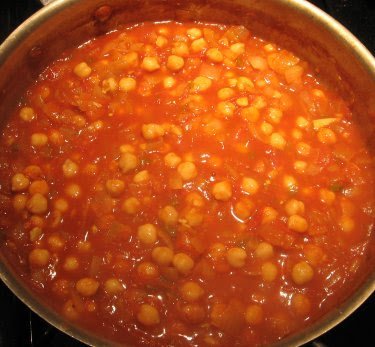
Poorly lit chickpea tomato curry

olive oil
onion
garlic
jalapeño/other hot pepper
(fresh ginger if you have any)
cooked chickpeas (canned or otherwise)
tomatoes
salt, pepper
powdered ginger, cumin, curry powder (or, realistically, whatever delicious curry spices you want)

I almost automatically wrote a nice intro paragraph about putting on your pot of rice first. HA! Instead: start cooking your polenta first. If you have a nice person who will stand around and continually stir it while you make the curry, all the better.

Ok! Chop up an onion and a handful of garlic cloves, then sweat them in olive oil over medium heat. Mince maybe half a jalapeño pepper and add it as well. If you have fresh ginger, excellent. Peel it, using the spoon trick: scrape the knob with a teaspoon and you'll remove the skin without wasting huge pieces of usable ginger. Mince it finely and throw it into the pan as well.

Let those cook together for a minute or two while you prep tomatoes. I used a combination of canned tomato puree and maybe four or five of my frozen-from-summer tomatoes, which worked fine. I think I'd cut up some canned whole tomatoes if I didn't have any frozen ones, but just using puree or whatever you have on hand should be fine. In summer you of course should use all the real tomatoes in the land. So. Chop any solid tomatoes into reasonable pieces and throw them into the pan.

Give everything a few minutes to cook down. The time here is going to depend on whether you need to reduce tomato pieces or just heat puree. Reducing tomatoes will take longer. I'd give it at least five minutes, more if needed.

Drain your chickpeas and throw them into the pan. Salt, pepper, and otherwise spice as appropriate. If you used fresh ginger, don't put additional powdered ginger in; I'm just saying. If things look too thick, add some water to thin the business out.

Now you can essentially let everything stew together until it's obviously delicious and you're ready to eat.

Put some polenta (or, yes, you can use rice, or whatever) into a bowl. Make a dent in the top like you were serving mashed potatoes, if you want. Then add a massive and exciting amount of curry. If there's anything you want to strew artfully over the top, like chopped cilantro leaves or maybe roasted peanuts, be my guest.

Now eat it.

The leftovers are awesome, and clearly better lit.

When you run out of the curry, you can have any polenta left with that poached egg and hot sauce. Mine was actually fried, due to serious lack of poaching skills. It doesn't matter. You could even have polenta and curry with the fried egg on top. It would still be delicious.
19 March 2010

What's going on?

Every so often I sort of forget that I actually know a bunch of active people online. I'm thinking this is a side effect of working at home by myself. But then! Then one day I go check my stats and discover a huge bump, courtesy of bewildery. Uh. Hi, mefites!

Ok, since this is about cheap, healthy, awesome food, let me perhaps dig up a couple of my favorite things.

- Pasta lenticchie, aka pasta with lentils. Essentially, thick lentil soup with tiny tubetti. It's like pasta fagioli with no bean soaking required.
- Speaking of beans, you should definitely make your own refritos. These are classic pintos, but I also make refried black beans all the time.
- You cannot beat the classic egg on toast, particularly with a handful of green beans.
- I like to put greens in everything. For instance: kale quesadillas.
- Cabbage braised in red wine. You can't get much cheaper and healthier than cabbage, and the wine can totally be two buck chuck. Or I guess it's three buck chuck now? It's been a while.
- Savory chickpea pancakes. I've never actually seen anybody else make these, but they are awesome. With fresh summer veg and basil, they are excellent by themselves. With winter cabbage/carrot/green onion, they are ripe for hoisin sauce.
- Biscuits and carrot dill soup: these are great and would be perfect at this time of year.
- Roasted cauliflower made the blog rounds a bit ago, but it remains delicious.
- You know what else is awesome? A liverwurst sandwich.
- How about a massive salad conglomeration? This one is part nicoise, part potato salad, and all really good.
- Oatcakes. These biscuits have next to no ingredients and yet are delicious. Also included: discussion of freezing soaked and boiled beans. An excellent technique that I do all the time.
- Lentil kibbeh may look a lot like the oatcakes, but they are very different, as well as very tasty.
- Speaking of oats, you should definitely make oatmeal. I don't do any of the fancy oat treatments that have been going around, and yet my oatmeal is still awesome.
- You can make yogurt into cheese, and it doesn't even take any cooking. You can also make the world's greatest scrambled eggs, if you so list.
- Straight up chili is one of the best soups to make in a huge batch. Then you can freeze the leftovers and have homemade chili whenever. Yeah!

Right, I need to stop before I end up just pointing at my entire backlog. However, the point remains. Yay good food!